
Update: Research Modernization NOW Is Now its Own Dedicated Website
Our new, dedicated Research Modernization NOW website is a living scientific and policy resource for scientists, educators, and advocates to learn about and support the transition away from animal experimentation and toward human-relevant research methods.
Like our Research Modernization NOW report, the website provides an overview of:
- The limited predictive value of experiments on animals
- How the current oversight system fails to prevent the worst from taking place
- The scientific and economic advantages of human-based technologies
- The global progress that’s sparking a paradigm change to superior, ethical science
- An evidence-based roadmap to change the paradigm
More than 40 appendices expand on specific disease areas—such as psychiatric conditions, inflammatory disorders, women’s health, xenotransplantation, and more—as well as medical education, toxicity testing, and laboratory production methods.
Housing this resource on its own site instead of in a static PDF will allow us to keep it dynamic, as the most up-to-date information is critical for navigating this rapidly evolving landscape.
From the website, you can also download and print the entire Research Modernization NOW report or a specific section to use for advocacy, policymaking, or education.
Update: NIH and FDA Prioritize Human-Relevant Research
In April 2025, the National Institutes of Health (NIH) announced a number of new initiatives aimed at reducing the use of animals in NIH-funded research. These include expanding funding, training, and infrastructure to support human-relevant, non-animal methods—recommendations from PETA’s Research Modernization NOW.
This shift aligned with a similar announcement by the U.S. Food and Drug Administration (FDA).
In a joint NIH-FDA webinar in July 2025, Acting NIH Deputy Director for Program Coordination, Planning, and Strategic Initiatives Dr. Nicole Kleinstreuer announced that the agency would no longer issue funding opportunities that exclusively request animal models, a change SAO has advocated for. All NIH calls for proposals now include language encouraging the use of non-animal methods. Learn more about what this means.
In September 2025, NIH announced the opening of the Standardized Organoid Modeling Center, a national resource for human organoid models. PETA has frequently advocated for the agency to create such hubs for human-based, in vitro technologies—as in this 2023 public comment to NIH—as a way to accelerate the continued improvement and validation of complex cellular models and provide technical support to scientists throughout the U.S.
In December 2025, the FDA called on the pharmaceutical industry to replace animal tests conducted to meet FDA requirements and invited the entire industry to actively bring their non-animal approaches forward. The following month, the U.S. Environmental Protection Agency (EPA) reaffirmed its commitment to eliminating animal tests.
In March 2026, NIH announced a $150 million investment in non-animal research methods, including the establishment of technology development centers, a data hub and coordinating center, and a validation and qualification network. The announcement came after SAO presented evidence on the failures of experiments on animals in cardiovascular, gynecological, neurological, rare disease research, and the need to support human-relevant methods in these fields and others.
Research Modernization NOW provides a roadmap for revitalizing the U.S. biomedical research enterprise.
Numerous scientific studies and reviews reveal that experiments on animals fail to lead to effective treatments and cures for many debilitating and deadly human diseases. Animal experimentation diverts funds away from more promising research approaches, delays the development of effective drugs and treatments, and limits our ability to treat and cure human disease.
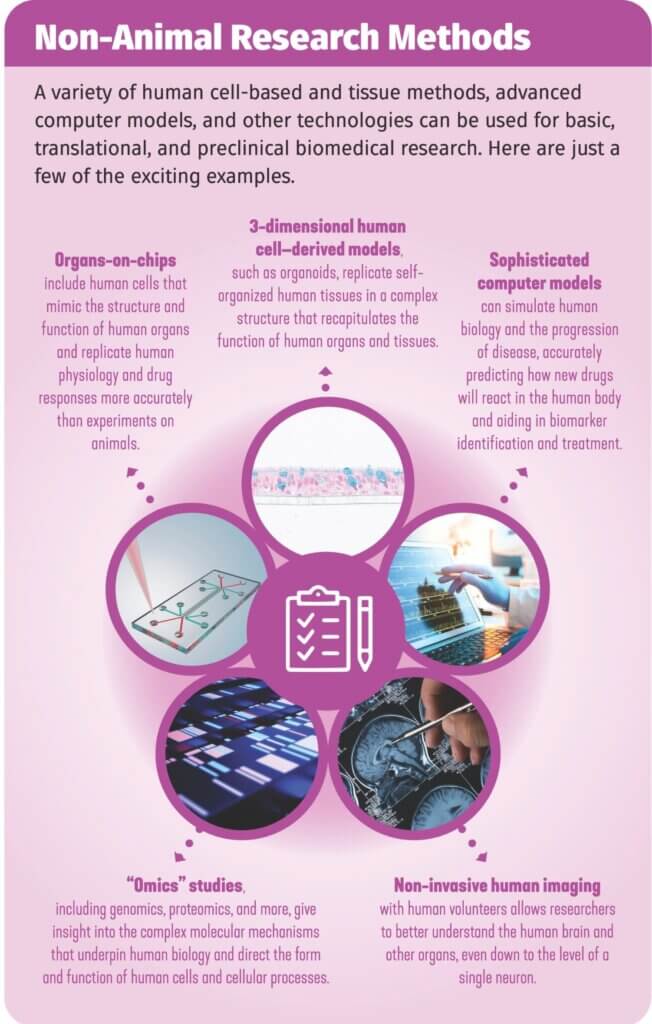
The National Institutes of Health (NIH) oversees Americans’ health and is the largest funder of biomedical research in the world. While the agency is making steps in the right direction, it still spends billions of dollars annually on experiments on animals. We need a better way—and our scientists have devised it.
Research Modernization NOW outlines a framework for optimizing our nation’s investment in research to treat and cure disease. Policymakers, funders, institutions, and researchers should use this resource to plan the necessary interventions to end funding for ineffective strategies (i.e., experiments on animals) and focus on human-relevant research.
By the numbers:
Animals are heavily used in preclinical studies, yet up to 89% of these studies are not reproducible, despite reproducibility being a critical component of scientific research.
Ninety-five percent of all new drugs that test safe and effective in animal studies fail in human clinical trials, most because they don’t work or are harmful to humans.
The failure rate of new drugs developed using animals in specific disease research areas exceeds 95%. Here are a few examples:
What Does Research Modernization NOW Propose?
Research Modernization NOW maps out a strategy for replacing the use of animals in experiments with human-relevant methods. It includes the following:
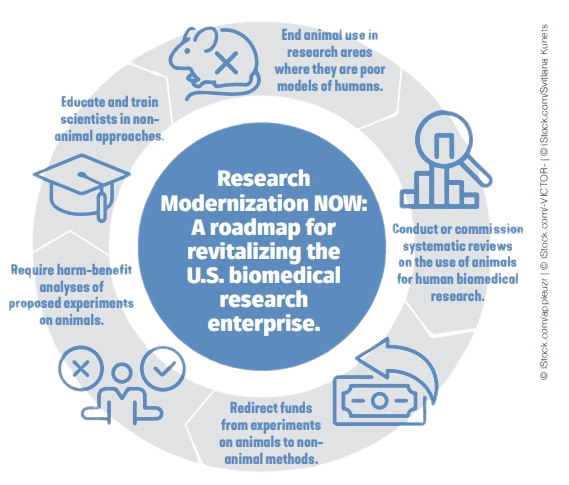
- Ending animal use in research areas where animals have been shown to be poor “models” of humans and their use has impeded scientific and medical progress.
- Conducting systematic reviews of the efficacy of animal use to identify additional areas where non-animal methods are available, or animal use has failed to protect human health, and can, therefore, be ended.
- Redirecting funds from animal studies to reliable, non-animal methods.
- Implementing a harm-benefit analysis system for animal studies includes an ethical perspective and considers the lifelong harm inflicted on animals.
- Educating and training the scientific community on the benefits of, and how to use, non-animal approaches.
Compassion and scientific breakthroughs aren’t mutually exclusive. Good science and sound ethics can propel us toward the shared goal of better health.
—What You Can Do—
This transformation can begin today. Without it, the research funded by U.S. taxpayers will fail to yield the discoveries and applications needed to protect human health.
Please send a polite e-mail to your members of Congress, urging them to put Research Modernization NOW into action.