Science Advancement & Outreach at the Shock Society Annual Conference in Boston
Written by Emily R. Trunnell, Ph.D.
June 2025
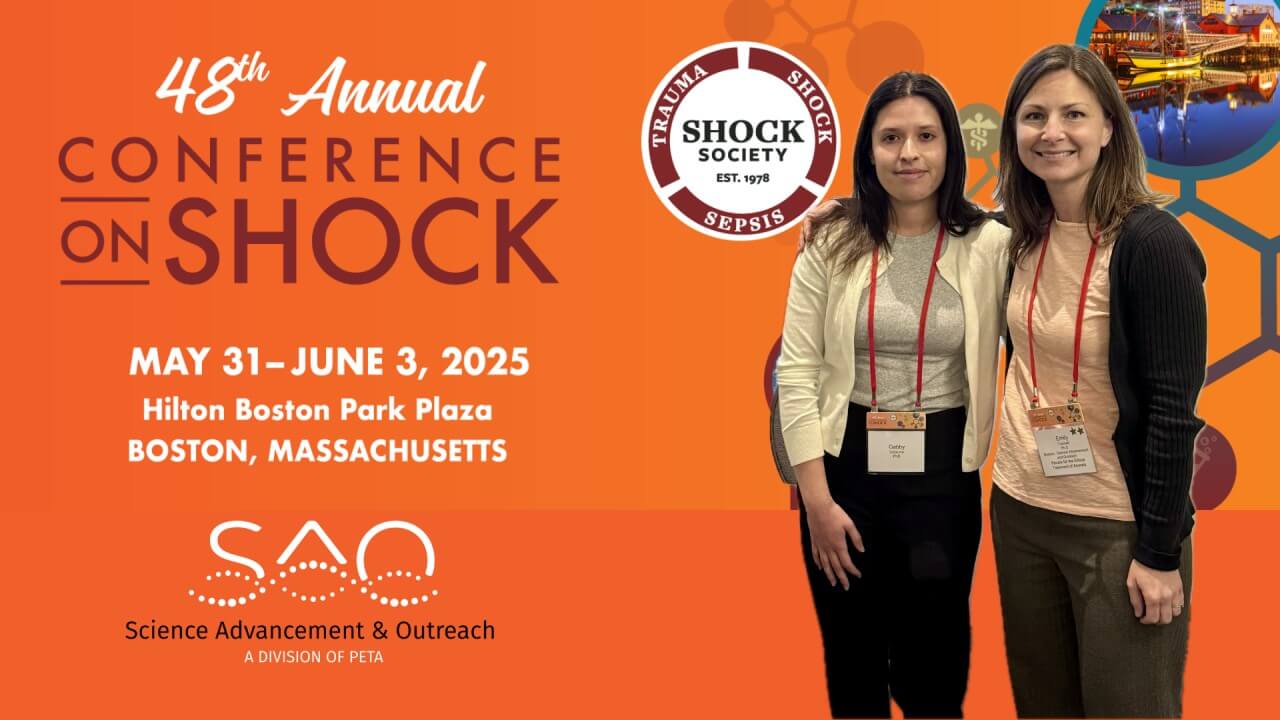
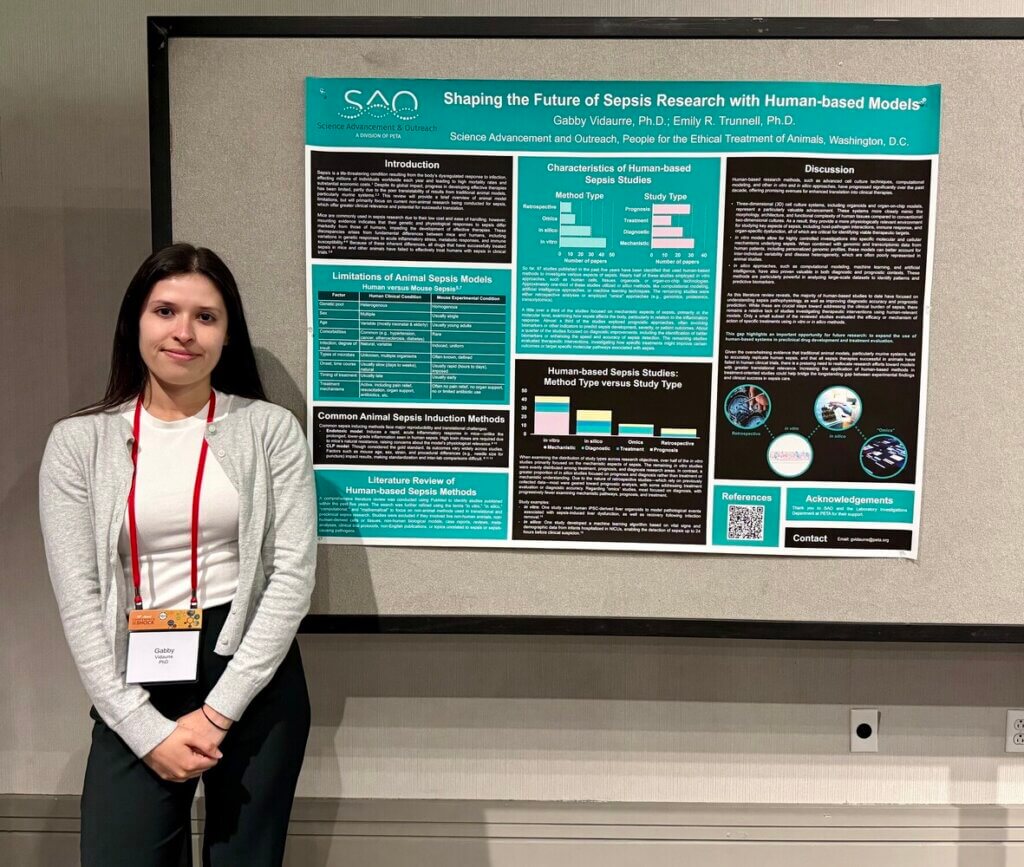
Last week, Science Advancement and Outreach attended the Shock Society‘s annual conference in Boston, where Dr. Gabby Vidaurre shared her poster on non-animal methods for sepsis research. We had great conversations, got an update on National Institute of General Medical Sciences (NIGMS) priorities, and heard about exciting studies.
Update on NIGMS Priorities
We were fortunate to hear directly from NIGMS division head Dr. Rochelle Long, who reaffirmed that the institute’s priorities for sepsis research are based in human biology and that they are “not a fan” of rodent models of sepsis.
NIGMS has initiatives to help current animal experimenters form collaborations with clinicians so they can acquire human samples and pursue non-animal sepsis research. Some examples include efforts to enable the use of human biospecimens and the APS Consortium, a collaboration with the National Heart, Lung, and Blood Institute .
For all areas of research, Long encouraged scientists to think critically about their models and avoid “just going back and doing something in a lab in a way that’s easy or was done that way in the past.” Human-based research should be everyone’s goal.
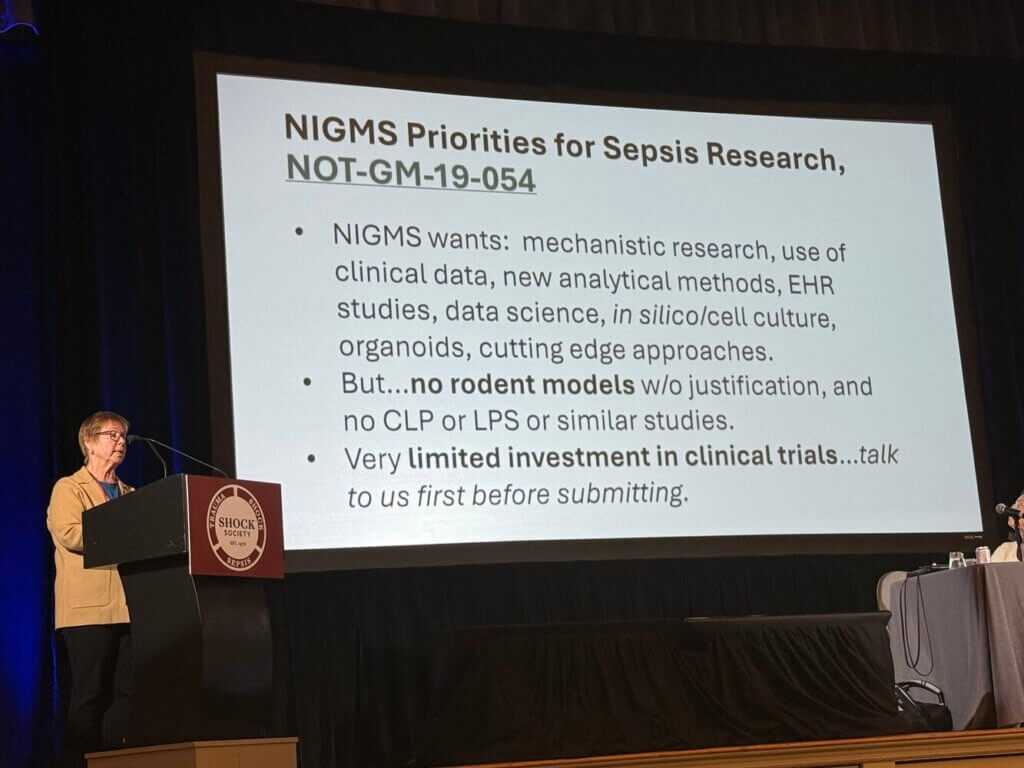
These were perhaps not welcome words as more than half of the talks and posters we saw described sepsis experiments on mice and rats using LPS, CLP, and similar methods. But, as Long noted, human-based research is “a way for the future that everybody sees coming and thinks is good.”
On that note, let’s take a look at some of the human-relevant research presented at the 2025 Shock Society Annual Conference.
Microfluidic Models
- Dr. Pearlson Prashanth Austin Suthanthiraraj of Pittsburgh Trauma and Transfusion Medicine Research Center presented new work assessing the quality of stored platelet transfusions using a microfluidic bleeding chip to evaluate their hemostatic capacity under different storage conditions.
- University of Cincinnati ‘s Dr. Gregory Wetmore presented a poster on a human microfluidic model to study early pulmonary vascular endotheliopathy.
- Bo Zhang of Case Western Reserve University showcased their in vitro human massive transfusion model.
Studies Using Patient Samples
- Dr. Matt Stier of Vanderbilt University Medical Center performed single-cell RNA-seq of PBMCs from healthy and critically ill patients and identified a unique subset of CD8+ T cells found only in the critically ill, offering new insights into the mechanisms of critical illness.
- Using a multi-omic approach, Seibi Kobara of Emory University School of Medicine analyzed plasma from trauma patients and found impaired anti-inflammatory responses and key cytokine-lipid interactions—potential therapeutic targets for mitigating ARDS in surgical patients.
- Dr. Eric Schmidt and team from Massachusetts General Hospital used mass spec to quantify endothelial glycocalyx shedding in sepsis patients and found heparan sulfate levels predict mortality, while chondroitin sulfate levels predict fluid resuscitation response—currently optimizing the test for hospital use.1
- Juliana Briggs of the University of Pittsburgh , Dr. Alexandria Byskoshof Brigham and Women’s Hospital, and Dr. Stephanie Wojtowicz-Piotrowski of McMaster University and Hamilton Health Sciences used samples collected from trauma and burn patients to study potential transfusion products and the effects of injury on immune and adipose cells.
- Dr. Angeliki Gkaifyllia of Yale Medicine collected samples from critically ill children with lung injury to conduct proteomic profiling.
More Notable Research
- Dr. Laurie Kilpatrick at Temple University Lewis Katz School of Medicine is exploring how neutrophil phenotypes influence sepsis outcomes and using in silico models to identify FDA-approved drugs for potential repurposing—paving the way for precision medicine in sepsis care.2
- Transplant surgeon Hunter Moore of AdventHealth gave a fascinating talk on the advantages of normothermic regional perfusion in organ donors as a human model for studying shock and fibrinolysis, areas where animal models fall short in translation.
- Dr. Filip Vlavcheski of McMaster University and Hamilton Health Sciences presented a poster describing work using a human organoid model for burn research.
- Sallee CJ, Maddux AB, Hippensteel JA, et al. CIRCULATING HEPARAN SULFATE PROFILES IN PEDIATRIC ACUTE RESPIRATORY DISTRESS SYNDROME. Shock. 2024;62(4):496. doi:10.1097/SHK.0000000000002421
- Yang Q, Langston JC, Prosniak R, et al. Distinct functional neutrophil phenotypes in sepsis patients correlate with disease severity. Front Immunol. 2024;15. doi:10.3389/fimmu.2024.1341752