SAO in Action: Highlights from the 2026 AAAS Annual Meeting
Written by Drs. Emily Trunnell and Gabby Vidaurre
February 2026
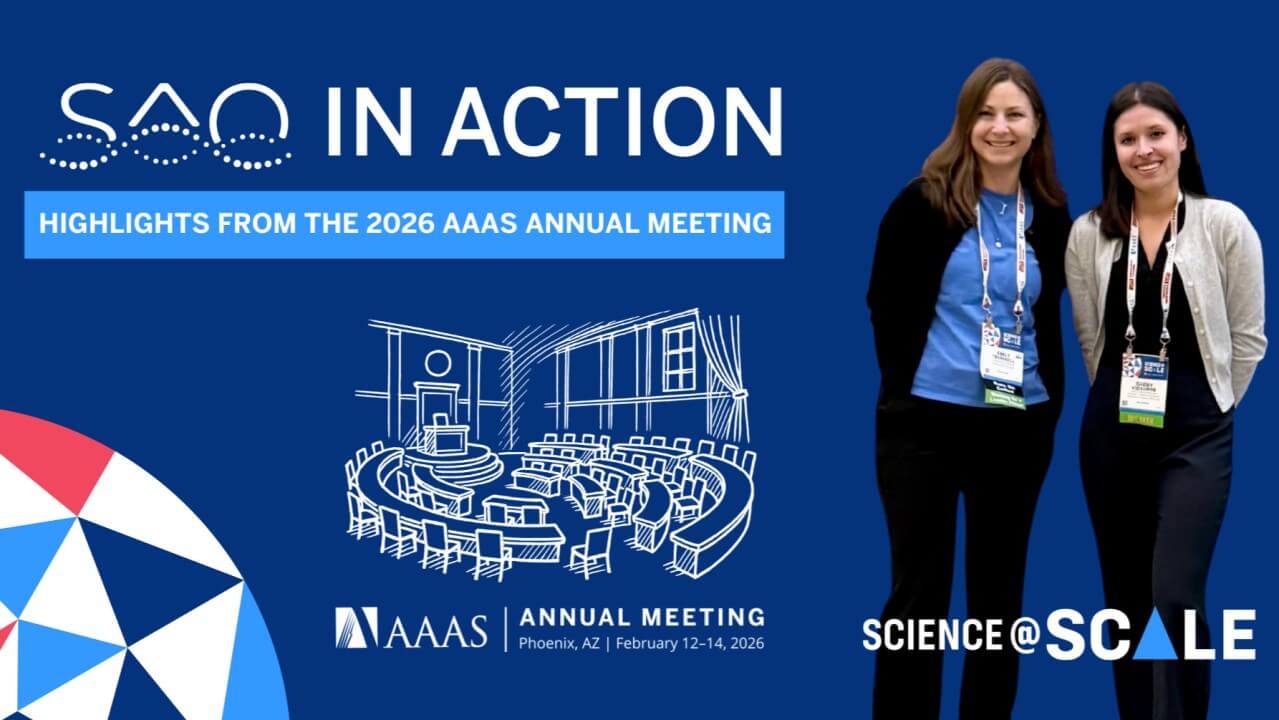
In the science policy space, AAAS is the annual meeting—the who’s who of where U.S. science and policy intersect. The theme of this year’s meeting, held February 12-14 at the Phoenix Convention Center, was Science @ Scale, an effort to “draw attention, more than ever, on daring to explore the inconceivable and embrace informed risk, while also conceptualizing value for the public good.”1
AAAS spans the full spectrum of scientific discovery, and it’s always energizing to step outside our biomedical bubble and hear what climate scientists, astronomers, engineers, and public‑health experts have been wrestling with—and celebrating—over the past year. It’s equally rewarding to share the breakthroughs happening in our own corner of science (shout out to the two particle physicists who are now organ-on-chip fans!)
Because the AAAS crowd is so broad, sessions relevant to SAO’s focus on biomedical research are naturally fewer, and those specifically centered on reducing animal use and advancing human-relevant science are rarer still. But in our fourth year attending, we noticed a meaningful uptick in presentations highlighting non-animal methods. This reflects both the huge boost2 these technologies have experienced in the past year and the growing momentum to use them, in part fueled by our continued advocacy.3
Science without animals: a scalable policy vision for the public good
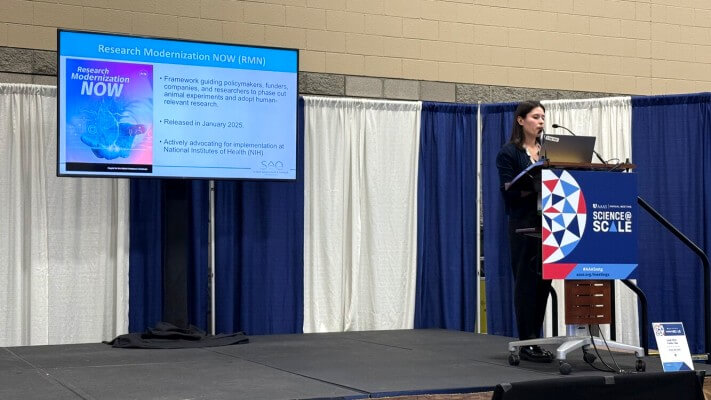
This year, SAO Research Associate Gabby Vidaurre, Ph.D, was selected to give one of the competitive AAAS Postdoc Talks. In “Science Without Animals: A Scalable Policy Vision for the Public Good,” Dr. Vidaurre discussed:
- Why there’s national and international momentum toward innovation without the use of animals
- How our policy roadmap, Research Modernization NOW, can fill in the gaps in existing strategies
- The actionable policy steps within Research Modernization NOW and how they can modernize biomedical research and improve human health outcomes
How AI is enabling new discoveries
AI was center stage at this year’s meeting. Across panels, symposia, and hallway conversations, one theme kept resurfacing: researchers in every discipline are using AI to speed up analyses and ask entirely new kinds of scientific questions. Whether modeling complex systems, integrating massive datasets, or translating messy biological signals into something humans can interpret, AI has rapidly become a catalyst for new discoveries.
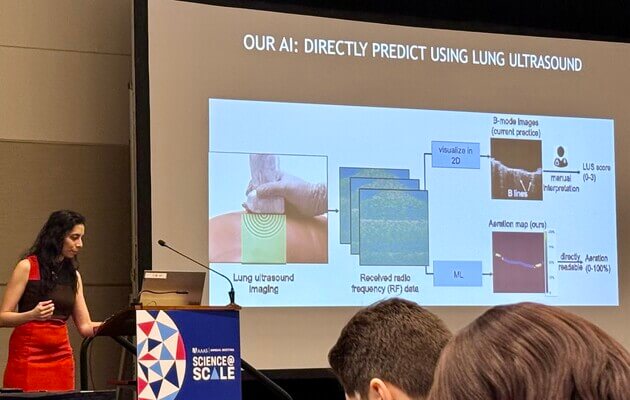
- In “Neural Operators for AI+Science: Pushing the Frontiers of Scientific Discovery,” Anima Anandkumar of the Caltech Division of Engineering and Applied Science shared the myriad uses of neural operators, “a special type of neural network that works with continuous mathematical functions rather than discrete data points.”4 In one study, her team was able to simplify the interpretation of lung ultrasound images,helping clinicians diagnose and monitor lung disease more rapidly and consistently.5
- In the panel session, “How the Human Exposome will unlock better health and medicine,” Thomas Hartung of the Johns Hopkins Center for Alternatives to Animal Testing (CAAT), discussed how AI and other computational technologies are revolutionizing the way we collect, integrate, and analyze human health data—enabling faster insights and more efficient pathways to improved health outcomes.
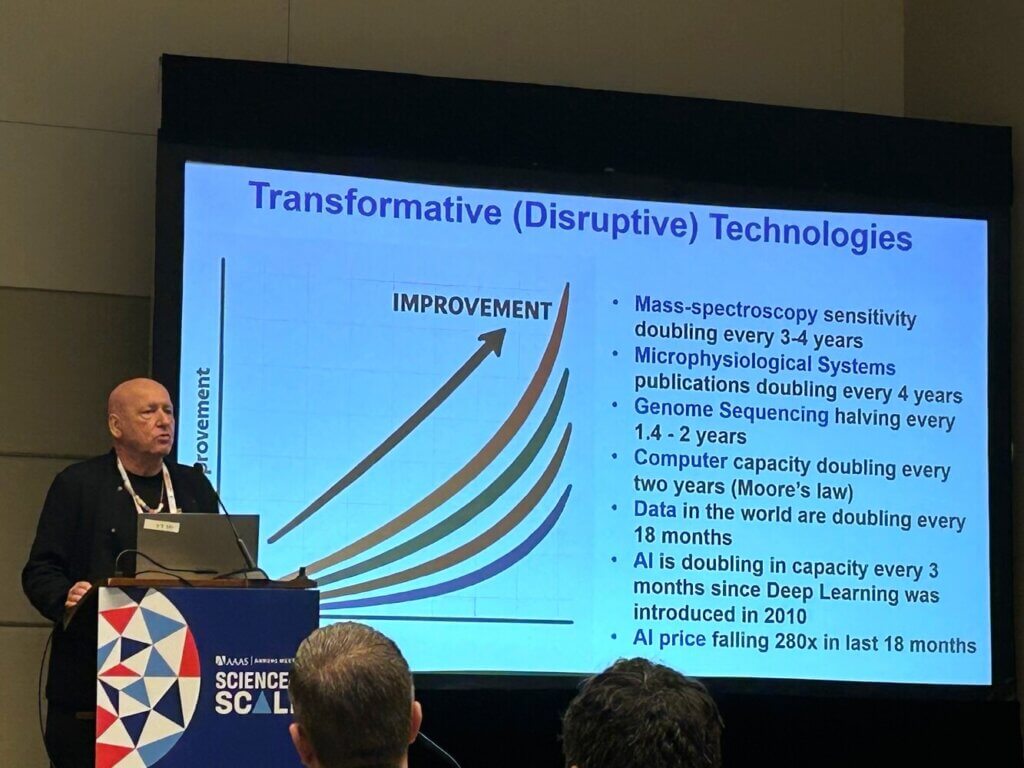
- On the Expo stage, postdoctoral researcher Lingfeng Xu of Arizona State University presented on the use of AI systems in clinical settings to distinguish healthy speech from disordered motor speech. He also emphasized some key considerations that must be addressed before deploying AI at scale in clinical applications.
A SNAP to attention: the kids are more than alright
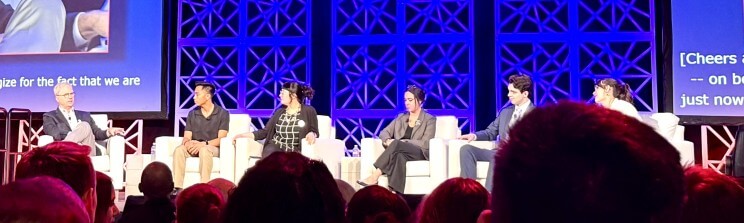
For the first time in AAAS’ nearly 180-year history, this year’s plenary was given by graduate students. Members of the Scientist Network for Advancing Policy (SNAP) Coalition joined Holden Thorp on stage to share how a few informal conversations at the 2025 AAAS meeting blossomed into a 120-member grassroots, early-career researcher-led organization that’s reshaping the culture of science and civic engagement.
Miles Arnett, Isako Di Tomassi, John Patrick Flores, Erin Morrow, and Alex Rich spoke about their vision for a future in which STEM education embraces communication training, fosters supportive relationships with mentors and advisors no matter the career goals, and empowers young scientists to engage meaningfully with policy. They also offered a glimpse of what SNAP has in store next. Learn more at snapcoalition.org.
Multiple standing ovations made it clear that these young scientists’ earnestness, leadership, and incredibly bright potential are a much-needed reminder that the policies we set now will affect the future generation of scientists—for better or worse.
Fraud’s fiercest foe
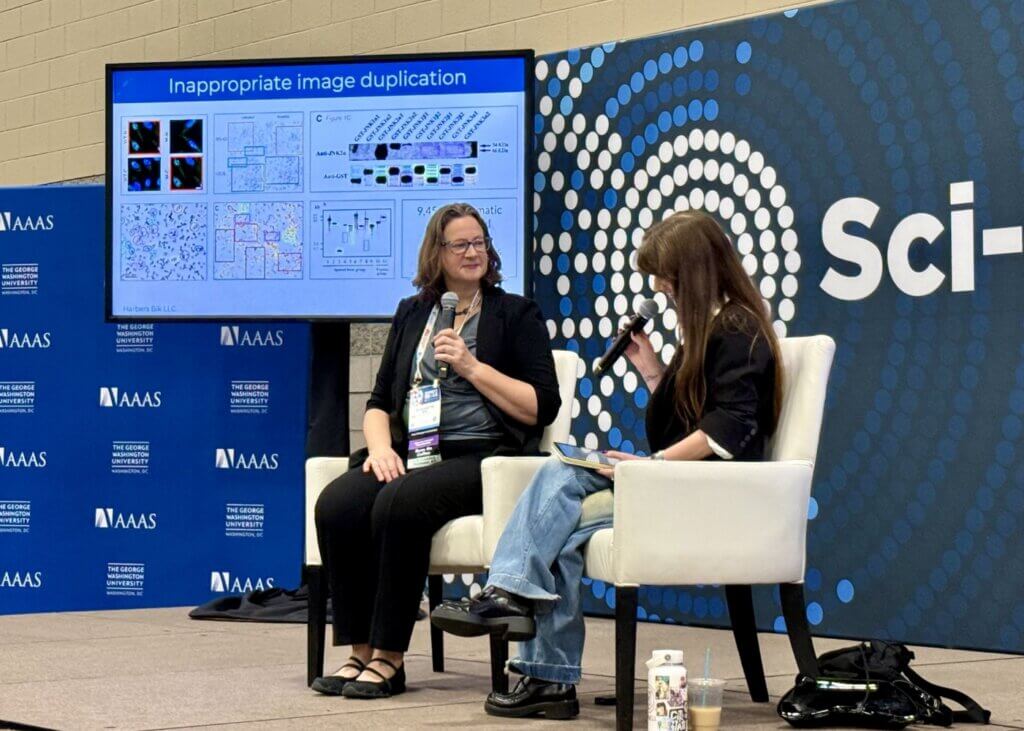
Science Sleuth Superstar Dr. Elisabeth Bik made two appearances on AAAS stages. At the Sci-Mic, Dr. Bik told Jessica Hubbard, MA, about her journey from academic microbiologist to self-employed image‑forensics analyst—and what it’s like being internet‑famous for exposing scientific misconduct.
Her work shows us that research built on fake or misleading images, flawed methods, or even outright fabricated data doesn’t just mislead the scientific community but also delays progress and perpetuates the use of animals in experiments by ‘legitimizing’ (publishing) irreproducible or unreliable findings. And as we see in cases where experiments proceed without proper approval,6 integrity failures ripple far beyond the lab. By strengthening research integrity and demanding accountability, experts like Dr. Bik help hold science to a higher standard.
Honorable mentions
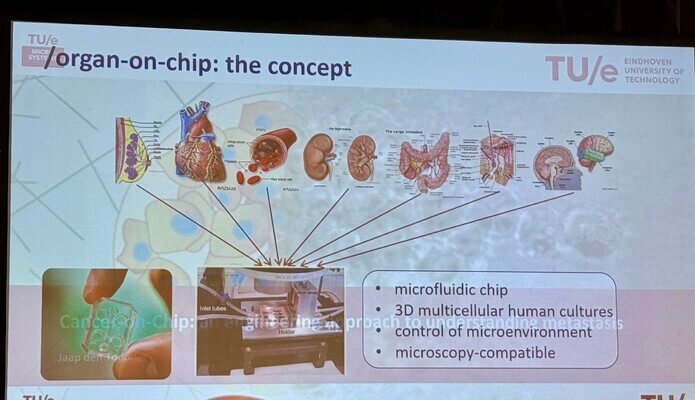
- In the panel session, “Game changers on the horizon for cancer,” Jaap den Toonder, Chair of the microsystems research section at Eindhoven University of Technology, showcased his lab’s groundbreaking work using engineered cancer-on-a-chip models to study the mechanisms of cancer metastasis and aid in the discovery of new treatments7.
- In the Expo Hall, we met ETHICS – EBRAINS-Italy Training, Human- AI Research, Innovation: Commons & Smartspace, a distributed infrastructure that aims to bring together the “most advanced modeling, computational and analytical technologies available in the neuroscience field.”8 EBRAINS representatives hope their work to collect scores of data on the human brain, and make it more accessible, can help reduce the use of animals in neuroscience experiments in Italy.
- Nicole Jimenez , Ph.D., of the University of Arizona College of Medicine – Phoenix, gave a postdoctoral talk on her research investigating the vaginal microbiome and its role in HPV infection and gynecologic cancer progression.9 Her work focuses on identifying putative oncogenic bacteria and understanding how they influence key cancer processes, including tumor-promoting inflammation and immune suppression, as well as their impact on the cervicovaginal microenvironment. Using multi-omic approaches—immunoproteomics, metabolomics, and genomics—combined with 3D human cell models and large clinical studies, she is working to uncover microbial biomarkers for cervical cancer risk and potential therapeutic targets.
That’s all for AAAS 2026! See you next year in Chicago!
1American Association for the Advancement of Science. AAAS 2026 Annual Meeting. Accessed February 27, 2026. https://meetings.aaas.org/
2Trunnell ER. Breaking: Human-Based Research Takes Center Stage at NIH. Science Advancement and Outreach Division. April 2025. https://www.scienceadvancement.org/reflections/human-based-research-takes-center-stage-at-nih/. Accessed February 26, 2026.
3PETA Science Advancement & Outreach Division. Providing Input to Government Agencies and Advisory Councils. Science Advancement & Outreach Division. Published 2026. Accessed February 26, 2026. https://www.scienceadvancement.org/resources/responses-to-government-requests-for-information/
4Caltech Division of Engineering and Applied Science. Modeling neurons with the help of AI. Published December 08, 2025. Accessed February 26, 2026. https://www.eas.caltech.edu/news/modeling-neurons-with-the-help-of-ai
5Wang J, Ostras O, Sode M, et al. Ultrasound lung aeration map via physics-aware neural operators. Preprint. ArXiv. 2025;arXiv:2501.01157v1. Published 2025 Jan 2.
6Joelving F. US-backed researchers in Colombia accused of experimenting on animals, humans without approval. Retraction Watch. Published April 27, 2023. Accessed February 26, 2026. https://retractionwatch.com/2023/04/27/us-backed-researchers-in-colombia-accused-of-experimenting-on-animals-humans-without-approval/
7Jouybar M, de Winde CM, Wolf K, Friedl P, Mebius RE, den Toonder JMJ. Cancer-on-chip models for metastasis: importance of the tumor microenvironment. Trends Biotechnol. 2024;42(4):431-448. doi:10.1016/j.tibtech.2023.10.001
8EBRAINS-Italy. The project EBRAINS-Italy is funded by the Nextgeneration EU and PNRR. Accessed February 27, 2026. https://www.ebrains-italy.eu/project
9Jimenez NR, Mancilla V, Łaniewski P, Herbst-Kralovetz MM. Immunometabolic contributions of atopobiaceae family members in human papillomavirus infection, cervical dysplasia, and cancer. J Infect Dis. 2025;232(4):767-778. doi:10.1093/infdis/jiae533