Reflections on Modernizing Sepsis Research, including insights from the 49th Annual Conference on Shock
Written by Gabby Vidaurre, PhD
September 2026
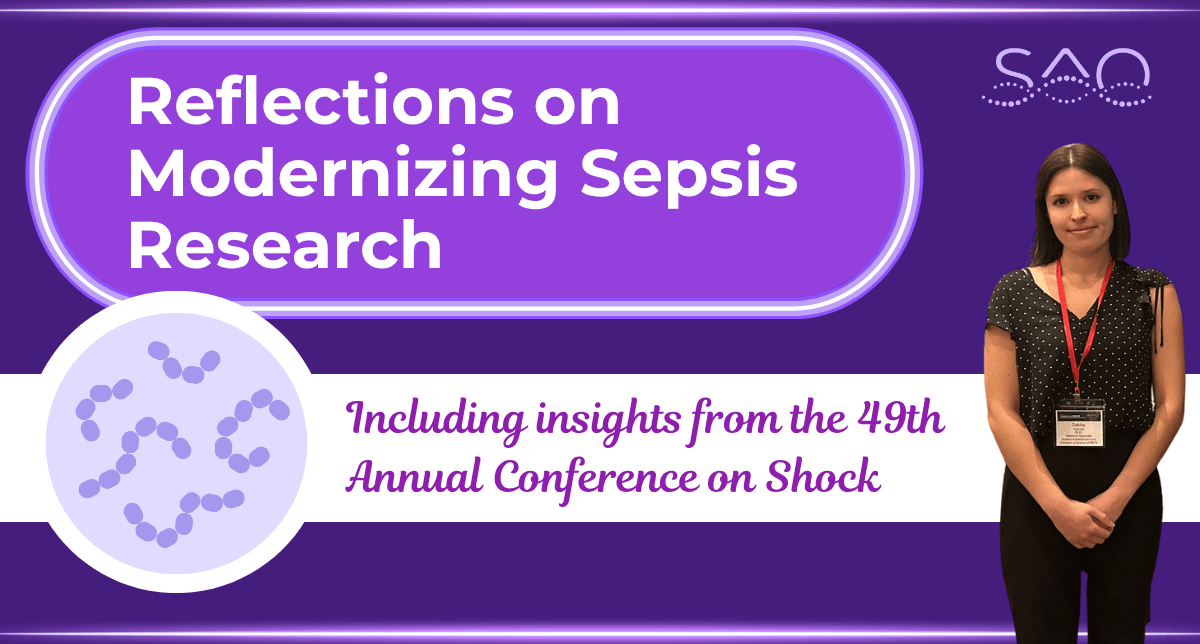
In June, I attended the Shock Society’s 49th Annual Conference on Shock, where I presented my poster, Modernizing Sepsis Research to Advance Human Health. The poster applied Science Advancement and Outreach’s Research Modernization NOW policy roadmap to sepsis research in the U.S., outlining actionable steps that policymakers, funders, research institutions, and other stakeholders can take to transition away from experiments on animals and toward human-based approaches to improve translational success and accelerate the development of effective treatments for sepsis.
Throughout the conference, I saw exciting examples of innovative, human-based science in the field of shock and sepsis. Researchers presented studies using advanced in vitro models, human clinical data, and computational approaches to better understand disease mechanisms and improve patient outcomes. At the same time, however, many presentations continued to describe experiments on animals despite decades of poor clinical translation.
In this reflection, I discuss the transition toward non-animal approaches, the claims used to perpetuate the use of animals in sepsis research, and why it is well past time for the field to embrace animal-free, human-based technologies.
Upending the Status Quo in Sepsis Research
While a number of presenters highlighted groundbreaking non-animal research (see this LinkedIn article), most non-clinical posters and talks described animal experiments to study human sepsis. Even some presentations that primarily featured human clinical data included experiments on mice. These made even less sense. If you’re already studying a human disease in humans, why perform additional experiments in another species? Too often, animal experiments seem to be perpetuated as a legacy expectation rather than a scientifically justified component of the research strategy.
These misaligned research approaches reinforced my impression that many researchers may continue to perform animal experiments because they remain an “expected” part of the research pipeline rather than a scientific necessity. Animal models—particularly mouse models—have been used in sepsis research for decades, and many seem to view them as a required component of a “well-rounded” study.
But just because you have been doing something for a long time doesn’t mean it’s working. Sepsis research is a proof point. The current status quo is very clearly not working.
To date, 100% of therapies developed specifically for sepsis have failed in human clinical trials.1,2 One major reason for this lack of success is the number of substantial biological differences between humans and the other species commonly in sepsis experiments. For example, a 2013 study comparing gene expression data from human patients with results from mouse experiments found that the genetic responses to severe inflammatory conditions, such as sepsis, burns, and trauma, differed markedly between the two species.3 The broader scientific literature has likewise documented differences between humans and other animals—including mice, pigs, baboons, and macaques—in immune responses,3–7 metabolic responses,8 microbiome composition,9 susceptibility to infection,10–12 and other biological processes13 directly relevant to sepsis.
In an attempt to improve the translational relevance of sepsis experiments on animals, researchers have developed international standards such as the Minimum Quality Threshold in Pre-Clinical Sepsis Studies (MQTiPSS).14 An updated version of MQTiPSS was presented at the conference, with new recommendations such as including both sexes, improving pain management, and incorporating vasoactive agents into study protocols. However, no matter how much an existing protocol is refined to better recapitulate the human sepsis environment, none of these changes can overcome the inherent species differences. Researchers could refine every aspect of an animal experiment, but it will remain restricted by nonhuman biology and be unable to replicate the human condition.
The “Whole Body” Excuse
Whenever discussions turn to NIH’s initiative to prioritize human-based methods—or to human-based methods more broadly—the explanation most frequently repeated for continuing the use of mice and other animals is that sepsis requires a “whole-body” system.
While a living animal is a whole-body system, it is the wrong whole-body system. Other animals cannot model the human body because inherent biological differences between species prevent the translation of experimental findings to humans, as discussed above. Although individual human-based methods may not yet replicate the full complexity of the human body, they can be combined to provide a systems-level understanding of sepsis.
Interconnected organ-on-chip platforms and the use of organoids alongside computational modeling are just two examples of how human-based approaches can be integrated to model interactions between multiple human organ systems. These approaches also allow researchers to investigate sepsis directly in human tissues and biological systems, providing a clinically relevant setting for evaluating potential therapies. Rather than attempting to make other animals increasingly resemble humans, we should focus on the available and emerging technologies that are human from the outset.
Non-Animal Methods for Sepsis Research are Here
One question I was asked repeatedly during my poster presentation was, “What non-animal methods can be used to study sepsis?” I found this particularly surprising, given that several researchers at the conference were presenting exactly this kind of work, using human-based methods to study the disease.
A wide range of approaches already exist for conducting sepsis research without animals, and we’ve known about them for over a decade. A 2015 report examining implementation of the 3Rs in sepsis research highlighted numerous non-animal methods that can be applied to study the disease, including 3D cell models for investigating sepsis mechanisms, computational approaches for mapping inflammatory pathways, and synthetic human models that recreate disease-relevant cell types and tissues. Human genomic studies can also help explain why individuals respond differently to sepsis and identify populations at greater risk of developing severe disease.15
The field has continued to advance considerably since that report was published. Researchers are using human iPSC-derived liver organoids to model septic liver dysfunction and recovery,16 lung-on-chip platforms to investigate immune responses and identify therapeutic strategies,17 microfluidic devices to monitor white blood cell activity18 and detect sepsis biomarkers,19 genomic sequencing to understand how genetic variation influences disease progression and treatment response,20 and artificial intelligence and machine learning tools to improve the early prediction and diagnosis of sepsis.21,22 These technologies are not hypothetical—they are already helping researchers answer important questions about human sepsis without experimenting on animals.
How Can Sepsis Research be Modernized?
Representatives from three NIH institutes—National Institute of General Medical Sciences (NIGMS), National Institute of Allergy and Infectious Diseases (NIAID), and National Heart, Lung, and Blood Institute (NHLBI)—were present at the conference, and each gave a presentation about their respective institutes’ opportunities for sepsis researchers. All three presentations highlighted human-based research opportunities, with both NIGMS and NHLBI emphasizing the Acute Respiratory Distress Syndrome (ARDS), pneumonia, and sepsis (APS) Consortium. These initiatives are an important step forward, but they’re not enough. Each institute must do more to support the development and adoption of non-animal approaches for sepsis research and the necessary shift away from experiments on animals.
Interest in adopting human-based methods within the sepsis field is already there, particularly among early-career scientists. During my poster session, I spoke with multiple early-career scientists who expressed interest in incorporating human-based methods into their research but faced challenges in doing so, such as working in laboratories built entirely around mouse experiments. Their experiences highlighted a major barrier faced by many researchers interested in transitioning away from experiments on animals: even when scientists recognize the need for non-animal methods, they often lack the training, infrastructure, and institutional support needed to make that transition. This is one major area where NIH could step up.
Moving away from established animal experiments would be accelerated through investment in education, infrastructure, and funding. Researchers need opportunities to learn how to use human-based methods, as well as financial support to overcome the time and resource costs associated with adopting new approaches.
To accelerate progress toward human-relevant sepsis research, NIH institutes—including NIAID and NHLBI—should build on NIGMS’s lead by redirecting resources away from projects that use animals to model human sepsis and toward studies that use human-based approaches.23 In addition, all NIH institutes supporting sepsis research should establish training grants and fellowships for researchers seeking to develop expertise in non-animal methodologies, partner with universities and research institutions to create educational programs focused on human-based approaches for sepsis research, and provide transition awards to encourage and support investigators to replace animal experiments in their labs with animal-free systems.
By implementing these initiatives, future iterations of this conference could look very different: more posters and talks showcasing diverse human-based approaches to study sepsis; early-career researchers sharing how their laboratories and institutions supported them in developing innovative animal-free methods; and conversations focused not on whether human-based approaches can be used, but on how we can continue improving them to accelerate the development of effective sepsis treatments.
- National Advisory General Medical Sciences Council. NAGMSC Working Group on Sepsis final report. May 17, 2019. Accessed September 16, 2026. https://www.nigms.nih.gov/sites/nigms/files/migrated/nagmsc-working-group-sepsis-report.pdf
- Collins F. Of mice, men, and medicine. NIH. February 19, 2013. Accessed September 16, 2026. https://us.pagefreezer.com/en-US/wa/browse/c530da90-f454-461b-9a86-959c53acb16c?url=https:%2F%2Fdirectorsblog.nih.gov%2F2013%2F02%2F19%2Fof-mice-men-and-medicine%2F×tamp=2025-05-27T10:13:51Z
- Seok J, Warren HS, Cuenca AG, et al. Genomic responses in mouse models poorly mimic human inflammatory diseases. Proc Natl Acad Sci U S A. 2013;110(9):3507-3512. doi:10.1073/pnas.1222878110
- Meurens F, Summerfield A, Nauwynck H, Saif L, Gerdts V. The pig: a model for human infectious diseases. Trends Microbiol. 2012;20(1):50-57. doi:10.1016/j.tim.2011.11.002
- Mair KH, Sedlak C, Käser T, et al. The porcine innate immune system: an update. Dev Comp Immunol. 2014;45(2):321-343. doi:10.1016/j.dci.2014.03.022
- Hawash MBF, Sanz-Remón J, Grenier JC, et al. Primate innate immune responses to bacterial and viral pathogens reveals an evolutionary trade-off between strength and specificity. Proc Natl Acad Sci U S A. 2021;118(13):e2015855118. doi:10.1073/pnas.2015855118
- Bjornson-Hooper ZB, Fragiadakis GK, Spitzer MH, et al. A comprehensive atlas of immunological differences between humans, mice, and non-human primates. Front Immunol. 2022;13:867015. doi:10.3389/fimmu.2022.867015
- Timmermans S, Libert C. Learning lessons in sepsis from the children. Mol Syst Biol. 2018;14(5):e8335. doi:10.15252/msb.20188335
- Chalupova M, Horak J, Kramna L, et al. Gut microbiome diversity of porcine peritonitis model of sepsis. Sci Rep. 2022;12(1):17430. doi:10.1038/s41598-022-21079-6
- Fink MP. Animal models of sepsis. Virulence. 2014;5(1):143-153. doi:10.4161/viru.26083
- Esmon CT. Why do animal models (sometimes) fail to mimic human sepsis? Crit Care Med. 2004;32(5 Suppl):S219-222. doi:10.1097/01.ccm.0000127036.27343.48
- Buras JA, Holzmann B, Sitkovsky M. Animal models of sepsis: setting the stage. Nat Rev Drug Discov. 2005;4(10):854-865. doi:10.1038/nrd1854
- Redl H, Bahrami S. Large animal models: baboons for trauma, shock, and sepsis studies. Shock. 2005;24 Suppl 1:88-93. doi:10.1097/01.shk.0000191339.46777.63
- Osuchowski MF, Ayala A, Bahrami S, et al. Minimum quality threshold in pre-clinical sepsis studies (MQTiPSS): an international expert consensus initiative for improvement of animal modeling in sepsis. Shock. 2018;50(4):377. doi:10.1097/SHK.0000000000001212
- Lilley E, Armstrong R, Clark N, et al. Refinement of animal models of sepsis and septic shock. Shock. 2015;43(4):304-316. doi:10.1097/SHK.0000000000000318
- Li Y, Nie Y, Yang X, et al. Integration of Kupffer cells into human iPSC-derived liver organoids for modeling liver dysfunction in sepsis. Cell Rep. 2024;43(3):113918. doi:10.1016/j.celrep.2024.113918
- Yang Q, Langston JC, Prosniak R, et al. Distinct functional neutrophil phenotypes in sepsis patients correlate with disease severity. Front Immunol. 2024;15:1341752. doi:10.3389/fimmu.2024.1341752
- Yang X, Pu X, Xu Y, et al. A novel prognosis evaluation indicator of patients with sepsis created by integrating six microfluidic-based neutrophil chemotactic migration parameters. Talanta. 2025;281:126801. doi:10.1016/j.talanta.2024.126801
- Sakuma M, Wang X, Ellett F, et al. Microfluidic capture of chromatin fibres measures neutrophil extracellular traps (NETs) released in a drop of human blood. Lab Chip. 2022;22(5):936-944. doi:10.1039/D1LC01123E
- Burnham KL, Milind N, Lee W, et al. eQTLs identify regulatory networks and drivers of variation in the individual response to sepsis. Cell Genomics. 2024;4(7):100587. doi:10.1016/j.xgen.2024.100587
- Steinbach D, Ahrens PC, Schmidt M, et al. Applying machine learning to blood count data predicts sepsis with ICU admission. Clin Chem. 2024;70(3):506-515. doi:10.1093/clinchem/hvae001
- Boussina A, Shashikumar SP, Malhotra A, et al. Impact of a deep learning sepsis prediction model on quality of care and survival. Npj Digit Med. 2024;7(1):14. doi:10.1038/s41746-023-00986-6
- National Institute of General Medical Sciences. Notice of information: NIGMS priorities for sepsis research. July 29, 2019. Accessed September 18, 2026. https://grants.nih.gov/grants/guide/notice-files/NOT-GM-19-054.html